| Construction Rating: | starstarstarstarstar_border |
| Flight Rating: | starstarstarstarstar_border |
| Overall Rating: | starstarstarstarstar_border |
| Diameter: | 0.98 inches |
| Length: | 22.00 inches |
| Manufacturer: | Estes  |
| Skill Level: | 1 |
| Style: | Sport |
Construction: Estes continues their tradition of well-written instructions; clear and orderly. Construction begins as usual with the motor mount. I am a bit disappointed with this in one way and glad of it in another. The motor mount consists of the traditional motor retainer hook, short body tube, and thrust ring, but the centering rings are replaced by an inch-long fiber ring. It's solid, but probably heavier than a pair of the thick 2050 rings everyone is used to. I added a Kevlar-elastic recovery harness to the motor mount by using a Mylar motor clip ring at the front of the mount to hold a Kevlar line end.
The fins went on straight without a hitch thanks to the wraparound marking guide included, and I used Aleene's Fast Grab white crafter's glue to assemble the rocket. PROs: Nice parts, crisp laser cutting, slick tubes.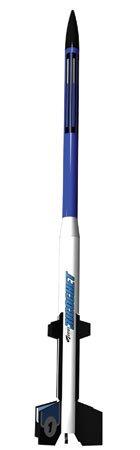 Brief:
A new pseudo-scale military single-stage rocket with SAM appeal.
This one was sold at my local Wal-Mart store in a cardboard box. Parts included were a motor mount tube, an engine hook, a long adapter ring, an engine block, a main body tube, an upper body tube, a balsa transition, a balsa nose cone, a sheet of laser-cut balsa fins, four hardwood strips, a launch lug, a screw eye, a 24" rubber band shock cord, a 12" parachute, and a classy sheet of three-color waterslide decals. All parts were there and undamaged.
CONs: Had to add the Kevlar to the recovery harness.
Finishing:
Since I rarely use white spray paint, I used a silver base coat with a blue color on the upper section. I applied four rubbed-in coats of white glue to all the balsa before applying paint and brushed the fins with three coats of black acrylic paint. I made one minor error on the painting: I painted the transition blue when it should have been the lower-rocket color. I feel the result only impacted the aesthetics, so I'll leave it alone. The waterslide decals went on easily.
PROs: Easy three-color paint scheme, nice decals.
CONs: Instructions weren't clear about painting the transition the base color.
Construction Rating: 4 out of 5
Flight:
I flew the Ricochet using four squares of Estes paper wadding each flight. First flight was on an A8-3. Straight as an arrow to 230 feet with parachute deploying just after apogee. Second flight was on a B6-4. Same song, second verse with an apogee of 577 feet. I swapped the parachute for a 24" streamer for the third flight on a C6-5. It topped out at 1120 feet and landed softly some twenty feet from my launcher.
Flight PROs: Nice straight boost, good selection of motors to choose from.
Flight CONs: You could lose this one with too much parachute.
Recovery:
I replaced the rubber shock cord with a Quest-type Kevlar-elastic harness. Each recovery was just after apogee. No burning, wear, or damage.
Recovery PROs: Worked as advertised.
Recovery CONs: See flight CON above.
Flight Rating: 4 out of 5
Summary:
This is a good mass-market rocket, easy to build but still requiring construction, with a nice SAM feel to it. Definitely an excellent rocket. If you built it with minor modifications it might be contest-suited for the Quadrathon event.
Overall PROs: Classy rocket, easy build but still a build, nicely thought out.
Overall CONs; None worth sweating...add a section of Kevlar to the recovery harness to fix the only trivial issue I have.
Overall Rating: 4 out of 5
Other Reviews
- Estes Ricochet By Rich DeAngelis (June 28, 2013)
The Estes Ricochet is a low power rocket kit. Although light, at 22 inches high it seems "bigger". It uses 18mm A,B and C motors. I like the military-missile style of this rocket. I enjoyed building this kit and I enjoy flying it because it flies well. Since it is relatively light, it flies to very high altitudes with the larger motors. It also has a large, narrow upper section you can use ...
 |
 |
Flights
|
|

John R, Brandon III (March 4, 2011)
Loose transitions and nose cone joints are common with balsa nose cones, less so with plastic ones. Am I the only one noting Estes trending back to balsa nose cones? Gotta say though that the harder balsa they seem to use is MUCH more easily finished than the old soft stuff.
Rich DeAngelis (May 31, 2011)
The Estes Ricochet was an enjoyable kit for me. I was attracted to it by it's design feature. The design appears to be inspired by a guided air-defense missle. The design includes extra little fin 'tabs' a few inches in front of the main fins which are attached to 4 balsa strips that extend forwards from the fin's leading edge. The kit has a reduced section forward of the parachute bay, useable as an extra long payload bay. The design also has an attractive paint scheme, which I followed exactly, with the exception of using a metalic blue paint in addition to gloss black and white. I prefer payloads so I can include a little Altimeter One and/or a recovery beeper safely in the nose. The instructions tell you to glue the forward body tube to the balsa parts - but don't! Just tape them up tight and you can use it as a (narrow) payload bay if you ever need one.
Building it was pretty easy, but I did make a bonehead cosmetic mistake. The trailing edges of the fins taper back before extending 90 degrees, like this |_/ \_|, but when I sanded the fins, I accidently sanded a little too much off of one fin on the inside taper, causing a slight difference in the root edges. When gluing them to the body, I lined them up using the trailing edge of the fin to the edge of the body, and as a result the four fins are not evenly placed fore-aft wise (only about 1/4 inch). As a result of that, the rocket will not stand upright by itself. Also, when gluing on the balsa strips and the smaller fin 'tabs', I aligned them using the mis-aligned leading edges of the fins, so the slight mis-alignment looks much more obvious. At least everything is straight and aerodynamically sound, it's just a cosmetic mistake.
Finishing it was more of a chore, having to balsa fillercoat, then prime, then paint white, then mask and paint black, sanding between all the coats. The upper tube section could be seperated and didn't need masking for blue paint, as well as the nosecone which was painted black. I applied 3 coats of clear coat after applying the water-transfer decals that were included, I also painted thin, 1/8" chrome bands around the balsa transition section and nose cone. It does look sharp - if you don't notice the fin allignment problem!
The (plastic) parachute included was plain white in color. It included a note from Estes stating something about laws not allowing them to use colored ink for the moment and suggested I could use markers or something, but I decided to leave it white since it looks pretty unique. The plastic sheet seemed a bit thicker and more durable than the usual parachute material.
The Ricochet flies pretty good. It's relatively light weight allows for A, B or C motors. I test flew it with a A8-3 and reached a height of a few hundred feet, the trajectory up was straight and uneventful. The small white parachute did a good recovery job without drifting too much.
Next month, I'll fly it with a B and C motor to see how much height I can get out of this pretty little projectile.
I would recommend replacing the standard Estes shock cord mount with a kevlar cord glued to the motor mount, otherwise it's good to go.
|
|
C.M. (July 20, 2009)