| Construction Rating: | starstarstar_borderstar_borderstar_border |
| Flight Rating: | starstarstarstarstar_border |
| Overall Rating: | starstarstarstarstar_border |
| Published: | 2011-12-05 |
| Diameter: | 1.58 inches |
| Length: | 22.00 inches |
| Manufacturer: | Quest  |
| Skill Level: | 3 |
| Style: | Scale |
 Brief
Brief
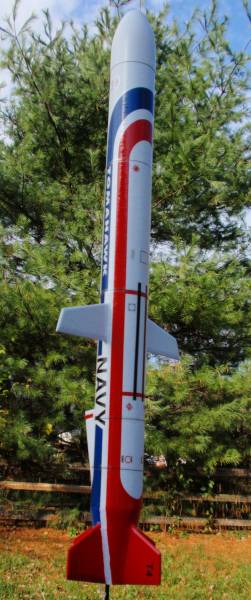
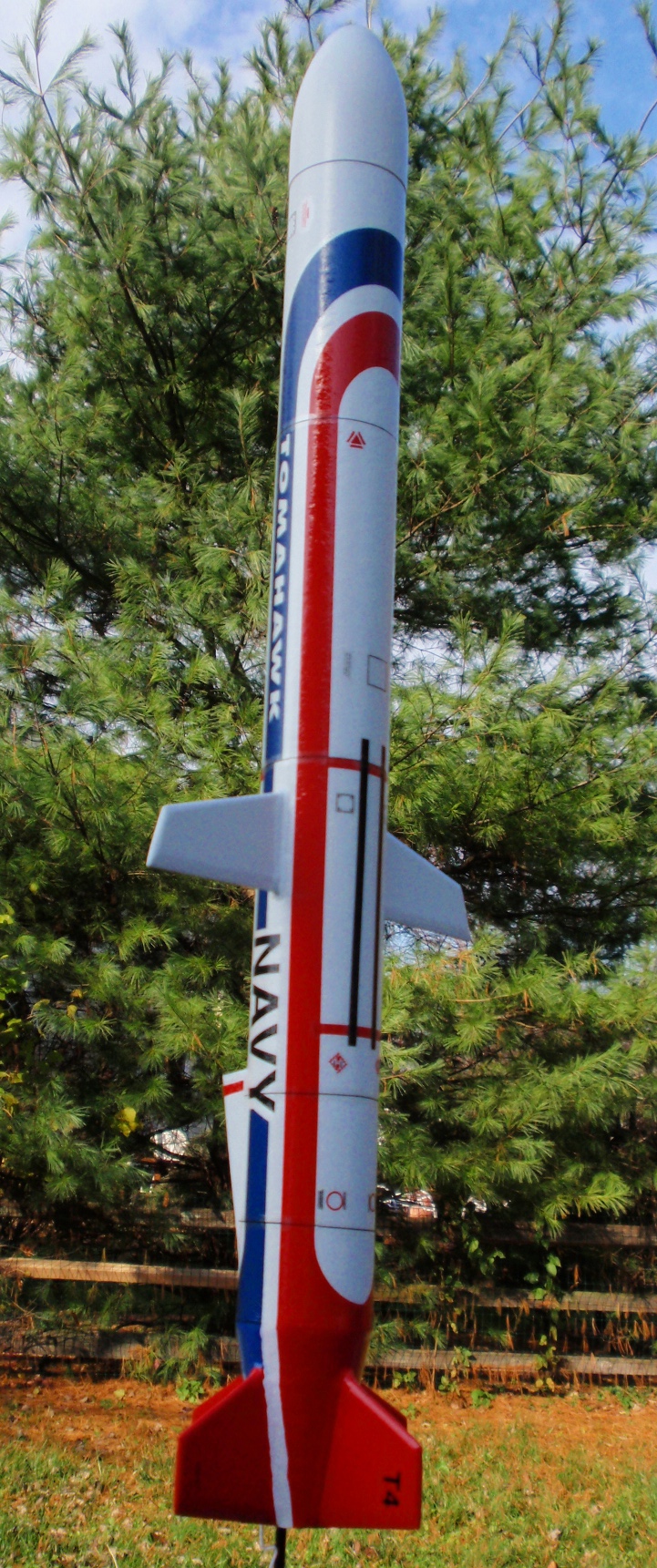
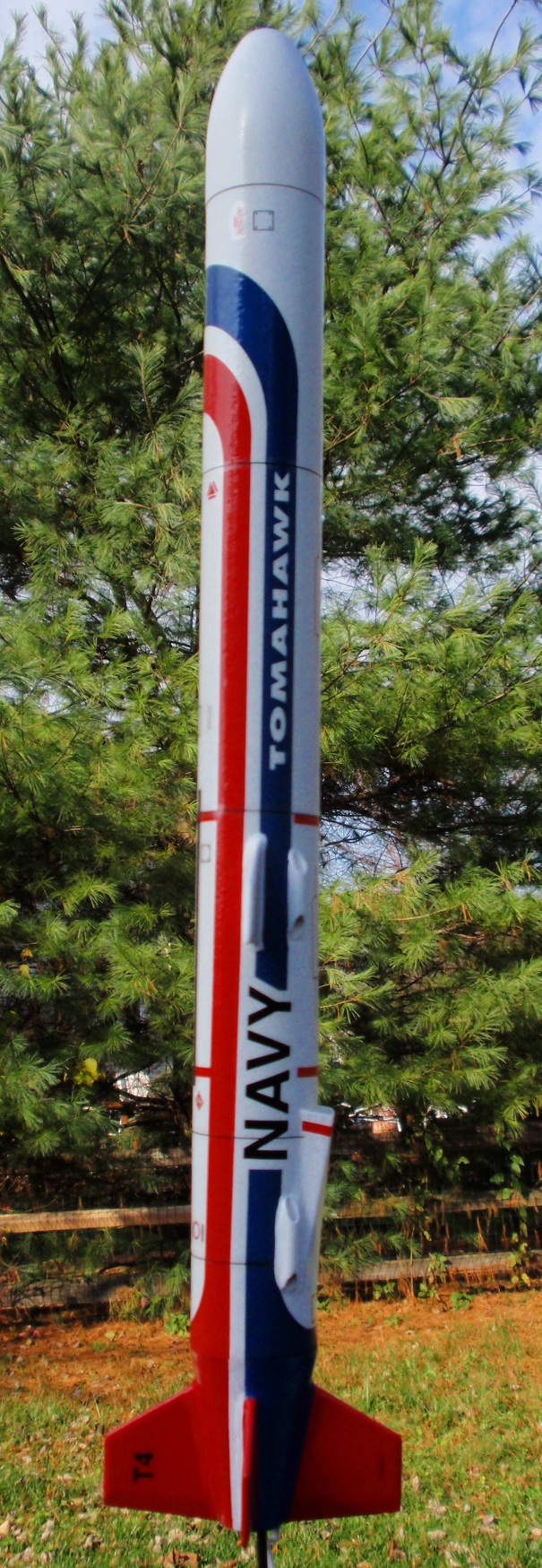
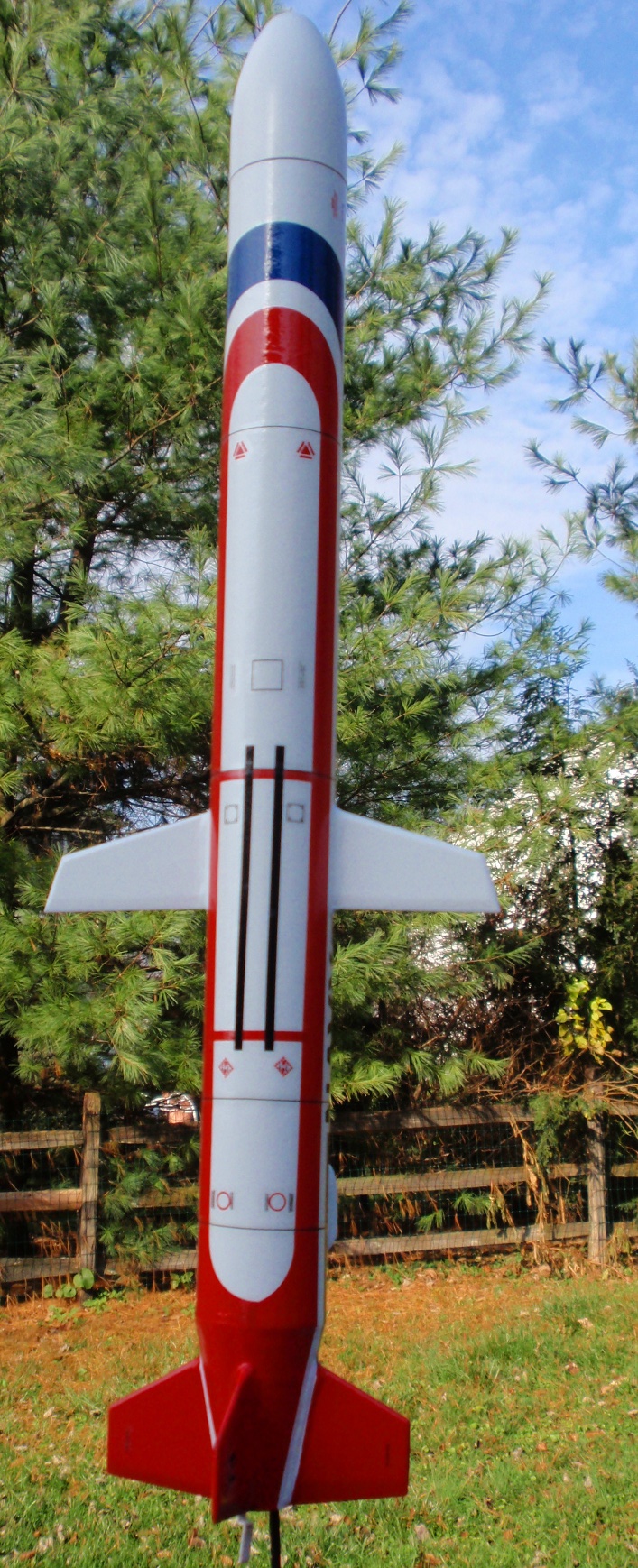
This is a standard, 18mm powered scale-like model of the US's cruise missle, in service since 1983 or '84 and used by the US Navy as well as the British Royal Navy. SLCM stands for Surface Launched Cruise Missle. The actual missle launches from a ship or even a torpedo tube of a submarine with a solid-propellant rocket motor, then the air scoop opens up, the wings deploy and the missle cruises on a small jet engine to it's target many miles away. The real aircraft is guided electronically and blows up at the end of it's flight, whereas the Quest model is supposed to deploy a parachute and land peacefully. The kit flies well, and the design features add to it's apperance, but makes it a slight bit harder to construct. The brite red and blue decals will add a definate eye-catching look to this model. If you have finally built enough basic rockets, this would be a good next step. I think it will provide some real challenges to a first-time builder.
Components
I have to give Quest good marks for the Kevlar and better quality shock cord rubber. I wish Estes would get with the program on this. Like Estes, it uses a motor clip with an extended tab on the end of it to make removing and inserting a motor easier on the fingers.
All the materials included in the kit seemed fine to me, but two things I noticed was 1) The nose cone seems a bit larger in diameter compared to the body tube. Just a slight difference of a millimeter or two, but enough to be noticeable. 2) The decals colors are not very precise, and since all the color of the finished kit does not come from the decals, it could be hard to match to the red and blue paints which are needed to finish the kit as suggested. I happened to have a second kit (the first one's body tube was severely damaged in shipping, I got a 2nd one for free, but didn't have to return the original kit, so I had plenty of spare parts including decals.) The decal's blue shade was quite a bit different between the two decal sheets. It looked more violet and didn't match the first set of decals at all. Since the first set of decals didn't quite fit in the boattail area, I used some of the second kit's blue decal, which is very off-colored. The first decal sheet's red matched Testor's red very well, the one blue was close to Testor's blue but still noticeable. The clear part of the decals also are quite visible when applied to white paint, unlike Estes decals which were much less visible. I wish I would have trimmed the clear areas more closely.
The supplied parachute shroud lines seemed like very thin thread, but appears strong. I pulled as hard as I could but could not break it. They are very light and it makes it easier to pack the chute, and yet they held up when deployed at a pretty high speed.
Construction
The instructions were fine, at least as far as construction is concerned, but I have several recommendations that were not covered by the instructions. I had issues with the instructions for the decal placements, as mentioned in the next section.
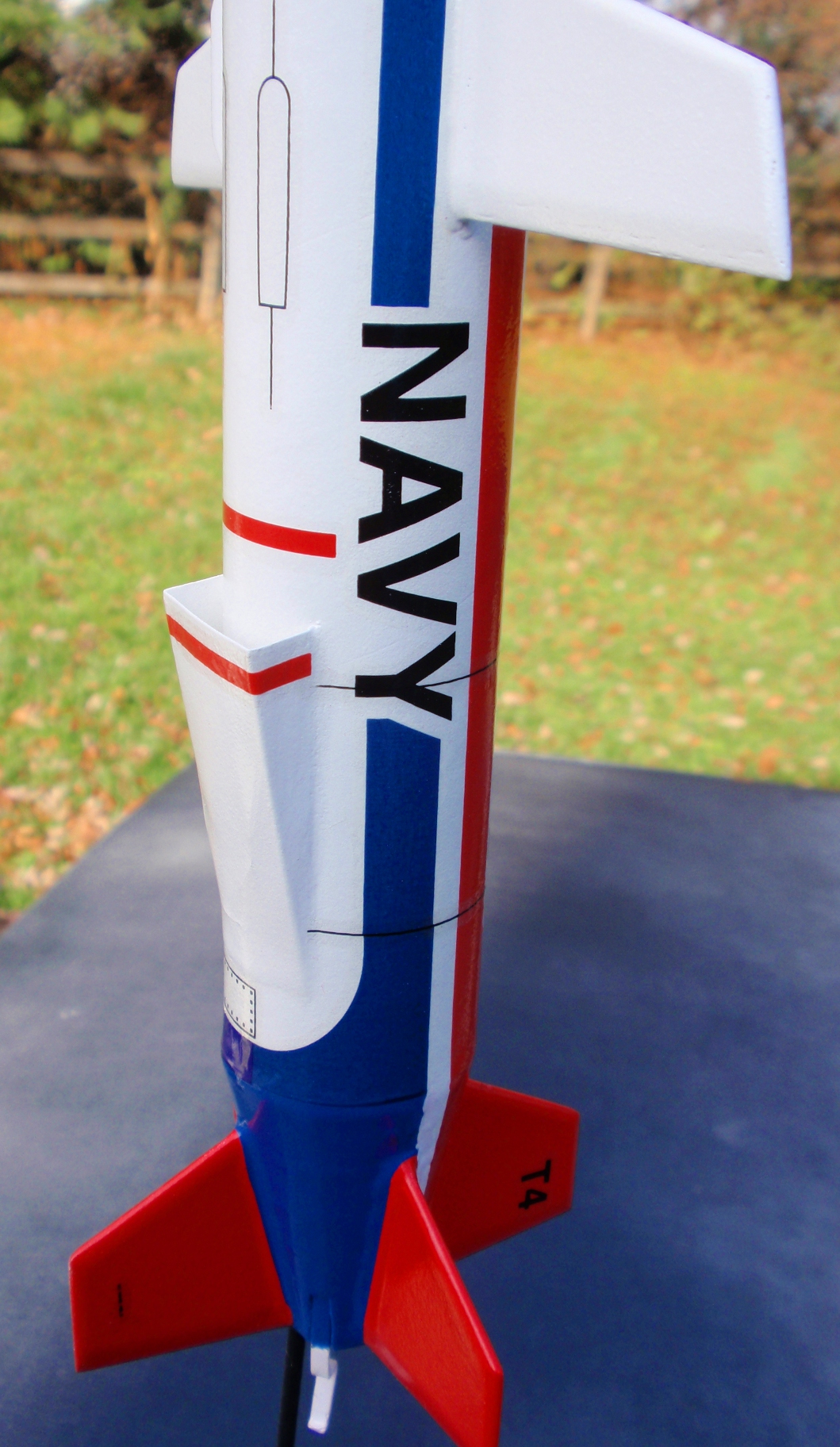
One unique feature of this kit is the boattail, made from cardboard. It will not be easy to do build this well, so take your time with it. I had some trouble figuring out a good way to clamp the cardboard accurately after gluing it together. I made every effort to build this as precisely as possible, but when attached to the body tube, there was some akward overlap. I used wood glue - NOT CA glue. I had to add Elmer's filler to the cardboard overlap and the joint to the body tube, and sand it to a smooth taper, but the shape of the taper made the application of the decals difficult to place over the slight curve and I had to add cuts to the decals for it to conform. I also found it necessary to add some filler to the back end of the air-intake to get a smooth finish to the body tube.
IMPORTANT: This boattail pattern does not have enough of an opening to insert/remove a motor without the metal motor clip tearing the cardboard - be sure to cut a larger opening into the cardboard before or after gluing it onto the motor mount. Test-fit a motor into it to see if the clip tries to tear the cardboard, and cut around the clip as necessary.
I thought that it might be a bit too weak, gluing the fins onto the cardboard of the boattail only. Note that the kit does supply an internal cardboard ring in the center of the boattail, so it's reasonably sturdy. For extra assurance, when I finished gluing the fins on, I soaked some CA glue into the cardboard to stiffen it somewhat. That seemed to work well as it is very stiff now. I wish I would have done that to the air-intake too, but I didn't until it was too late - when finishing the model and sanding it, the tight folds of the air-intake started ripping a bit. A quick application of CA glue seemed to fix that. Unfortunately, while applying the decals, I pressed a little too hard with the paper towel and bent the cardboard. The cardboard was fine, but it cracked the smooth white gloss finish of the paint. Take my advice and soak the entire air-intake with CA glue during assembly, or just use that as a pattern for a thin balsa intake.
You should realize that the air-intake adds some drag behind the rocket's center of pressure. This actually adds to the rocket's stability in flight, augmenting the seemingly too-small small fin area.
For the first time ever, I paper-covered the balsa fins and wings before attaching them to the rocket, and found this to work well and be much simpler of an effort than balsa fillercoats and sanding sealer. The paper can also add a bit of strength to the fins, or so I hope. Glue the paper onto the fin/wing surfaces with a generous application of photo-mount adhesive and press very firmly.
I know the clay noseweight should stay in the nosecone well, but since I was too afraid of it drying out and working loose some day years from now with out me noticing, I glued it in around the edges to help it stay in place.
Other than what I mentioned above, the rest of the kit build went very well, at least until I got around to finishing the model.
Finishing
The one problem I had with the instructions was with the lack of clear, detailed illustrations about where to put some of the decals. I had to make a few guesses, which I see are different then the guesses of other Tomahawk builders I found on this site. My kit did not provide a single picture of some of the sides of the model, so be prepared to be creative in the application of the decals. I recommend soaking the cardboard parts (air intake and boattail) with CA glue to stiffen them before finishing to prevent trouble later on.
Compounding this problem, it appears the exact dimensional-fit of these decals as shown on the color package card is quite a bit different than the real model parts, in the wing, boattail and air intake areas. I had to be very flexible in the placement of the decals (but who would notice?). Quest's decals seemed to require quite a bit of drying time compared to other decals. I would set some decals and be working on other decals when I would accidently dirsturb decals I thought were dry and fixed already. After several of these episodes, I just let the model sit for a day and went back the next day when I knew they were dry. The long red and blue decals along the length of the tube were in several sections, which were difficult to align well. You have to start at the back and work your way up each side seperately and when you get to the top - which connects both side halfs, you should pray that the two sides line up OK. I was saved however, by the slow-setting decals. If I just put them on in the last 10-15 minutes, I could re-wet them and slide them around easily to align them precisely. None of the decals tore, even though some of them were handled pretty roughly at times.
After having just completed an Estes Interceptor days before (known for it's enormous amount of decals), I found the Quest decals to be much more of a challenge to work with.
When the decals were finished and left to dry for a few days, I was about to do a string-stability test. I use a bit of masking tape to hold the string in place at the center of gravity. When I removed the tape, off came some of the decals with it! I was lucky and I had a spare set of decals so I could replace some of them. After those dried, I wanted to apply a layer of Testor's clearcoat to protect them. Immediatly after the clearcoat hit the decals, they began to wrinkle up. Apparently Quest's decals are not compatible with Testor's. So although the design is pretty sharp, my rocket now looks like crap due to the poor decals.
The other challenge is that the finish of the rocket - if you want to follow the finish suggested by Quest - requires some rather tricky masking of the boattail and fins. Tricky because the white-stripe area in the boattail has to match the thickness of the decals, and you have to mask along the irregular fin fillets which is never easy. With a primer and white basecoat, you have to mask and paint red, and then re-mask and paint for blue.
A good smooth-tapered filler application between the boattail and body tube can make applying decals easier, but you may still need to add some small slices to overlap the ends of the decals to fit them flat. I recommend using Scotch tape instead of regular masking tape - it provides a much cleaner edge, and if you press the edge in well, will not bleed at all. Depending on the decals you get - you may want to consider trying to match the shade of the red and blue paint to the decals, or the difference may be quite noticeable. If using spray paints though, good luck is about all you can count on.
Of course, if you are planning to toss the decals and design your own original paint scheme, go nuts...It will likely be much easier than the suggested paint scheme. I imagine you could do a lot with this kit, espically if you were to modify or omit the air scoop and/or the wings.
Flight
This model flies well with the recommended B6-4 and C6-5. In light winds these two seem to work well. In windy conditions the C6-3 seemed to work much better. I would also suggest a B6-2 in windy conditions, but I haven't tried that myself. This model lifts off with a seemingly slower, satisfying ascent that is a real joy to watch. My flights (with an altimeter on board) were not nearly as high as Quest suggests, measuring 132 feet and 57 mph on a B6 and 389 feet and 90 mph on a C6 motor.
On one flight the parachute ejected at a pretty high speed, but the tiny thread-like shroud lines held up just fine.
I might be crazy enough to try an 18mm Apogee D10 for some really outrageous flights!
Recovery
I'll be suprised if the recoil from the nosecone doesn't tear off a wing or two - we'll have to see about that.  So far I haven't had any recoil damage, just a bit of dirt smudges from the landings. As stated earlier, the parachute shroud lines seem a bit thin and weak, but they have held up to abuse just fine. The parachute may be a bit large for smaller field/windy conditions, but that is easily solved by cutting a inch or two of spill hole in it if necessary.
Summary
Overall Rocket Design: Good. Value for the dollar: Very Good. Difficulty to construct: Moderate. Decals: Not so good. Flies: Very well. Fun to be had: Very much!
Other Reviews
- Quest Tomahawk SLCM By Kris Henderson
Single stage, 18mm mount, parachute recovery, scale model of NAVY SLCM Tomahawk cruise missile. Water transfer decals included. Kit includes 1 body tube, 6 die-cut balsa fins, paper shrouds around tail and for the belly scoop, typical Quest recovery system that connects to motor mount with Kevlar and elastic lines, plastic nose cone, and water transfer decals. The instructions in this ...
- Quest Tomahawk SLCM By Joe Talento
The following excerpt is from "Sport Rocketry". The intention is to allow guests to get a basic feeling about a kit. We strongly suggest that you get a copy of the referenced Sport Rocketry and read the entire article. Inside you will find many helpful hints in construction as well as other useful information. For more information, use the two links above. (Sport Rocketry - Jan/Feb 1999 ...
 |
 |
Flights
Sponsored Ads


|
|