| Manufacturer: | Scratch |
(Contributed - by Ted Cochran)
Overview
I wanted to make something smaller, lighter, and more flexible. In particular, I wanted to make the tower easily reconfigurable for a number of standard sized rocket diameters. The first trick is to lay out the tower rods in a pattern that accommodates different rocket diameters. The second trick was to do this without creating multiple tower bases or a thicket of rods. The third trick was to enable easy adjustment, preferably without tools.
 As shown here, the solution was to create rods which fit into a
variety of sockets, which are themselves rigidly aligned in a base and arranged
in a pattern to accommodate rockets of standard sizes. These rods are
adjustable in that twisting them slightly varies the diameter of the circle
that they define, thus accommodating slight variations in rocket diameter
without the need for a halo.
As shown here, the solution was to create rods which fit into a
variety of sockets, which are themselves rigidly aligned in a base and arranged
in a pattern to accommodate rockets of standard sizes. These rods are
adjustable in that twisting them slightly varies the diameter of the circle
that they define, thus accommodating slight variations in rocket diameter
without the need for a halo.
Note that rockets of larger diameters can be accommodated merely by adding rods in increasingly larger triangles. Since the sockets are cast into a base using layers of epoxy separated by polystyrene filler, rigidity is achieved in a relatively lightweight package (at least when compared to buckets of concrete!).
Construction
Parts List
| Quantity | Description |
| 3 2 1 1 1 1 3 1 2 2
|
1/4" ID Brass Tubing, 3' long 1/4" aluminum channel stock, 4' long 1/4" plated rod stock, 3' long 3" PVC coupler 3" to 1-1/2" PVC flush busing 1-1/2" to 1/2" PVC adapter small bag of polystyrene granules (filler) 5/16" x 6" eyebolts 1/4" aluminum stop ferrule (fitting for steel cable) 1" rubber washers 1-1/2" fender washers 1/2" threaded iron pipe 1/2" gate valve tripod style roof mount for television antenna misc. nuts and bolts 4" blast deflector
|
Launch Pad
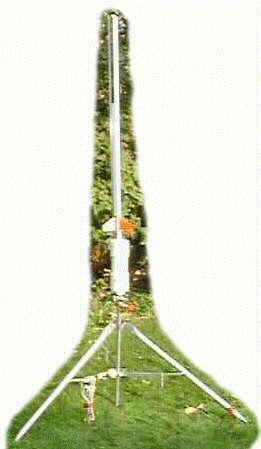
The launch pad is made from a TV antenna tripod, modified to permit it to squat lower with legs more widely spaced. A gate valve (an in-line water faucet with a clamping action) is used to rapidly switch rods or the tower head (which itself can accommodate two sizes of rods). [Thanks to Russ Durkee for the faucet idea (I do not know if it was original with him)]. I replaced one bolt in each of the tripods center rings with a thumbscrew to enable easy tightening and untightening of the tower in order to allow it to be folded up for transport.I've used this tower for two years simply by adding a 4" aluminum disk as a blast deflector and clamping various launch rods into place using the gate valve. It is extremely rigid, and has easily supported rockets up to 4" in diameter and 3.3 pounds gross weight. If necessary , the legs can be staked to further increase stability.
 For this
project, I added a tilt mechanism using plans for the
plumber's
pad on sunsite. I modified the plan only by using an aluminum ferrule as a
bushing within the eyebolts instead of washers. The ferrule is normally used on
1/4" wire cable as a stop, look for it in the cable section of a hardware
store.
For this
project, I added a tilt mechanism using plans for the
plumber's
pad on sunsite. I modified the plan only by using an aluminum ferrule as a
bushing within the eyebolts instead of washers. The ferrule is normally used on
1/4" wire cable as a stop, look for it in the cable section of a hardware
store.
- Modify the roof tripod by drilling one rivet on each leg brace and lengthening the brace with a short piece of lightweight chain. Replace one bolt in each ring with a thumbscrew (the left rear one in the picture below).
- Add center pipe (1/2" galvanized water pipe) and gate valve quick mount.
- Construct a tilt mechanism using the plans for the plumber's pad in Sunsite archives. This is simply three eyebolts and aluminum bushing with rubber washers between bolts and metal washers outside them.
Tower Head
These diagrams illustrate key stages in construction of the tower.
- Create rods by epoxying 6" of 18" of plated 1/4" rods into channels of 1/4" aluminum extrusions. (Photo A). The extrusions are widely available and are typically used to line the edges of plywood. The 1/4" rods are a perfect fit into the channels.
- Create a set of sockets by cutting 1/4" I.D. brass tubing to size. Carefully deburr the ends of the brass tubes. The O.D. should be 5/16" and the 1/4" rods should fit perfectly. You may wish to lightly wax the rods for ease of insertion.
Insert three [optionally four] rod assemblies into their sockets. Prepare an 18 mm body tube by marking three equally spaced lines along its length. The tube should be stiffened by inserting expended motors, and you may wish to add an additional width of masking tape or cardboard around the tube to provide a bit of free play. Use hose clamps or wire ties to secure three rod/socket assemblies to this body tube, using the lines as guides. Fashion two cups from a short length of PVC tubing and masking tape, and position at the base (leave just enough room to allow the epoxy to stealth bottom of the sockets) and near the top of the sockets. Add some spare galvanized screws or other hardware to cups to facilitate later bonding to additional socket assemblies. Hang vertically, and fill with 30 minute epoxy (Photo B).- Remove mold (Photo C). Looking at this assembly from the top, let's number the sockets from 1 to 3 clockwise. Number two will be the center of the finished tower, and the only socket that is always used. Prepare a 24 mm body tube as in previous step. Remove the rod from socket number three in the assembly created in the previous step, and insert it into a new socket. Using nylon ties or hose clamps, secure this new socket and rod assembly and rods 1 and 2 from the assembly built in the previous step to the body tube. Fashion molds as before, I found it easiest to offset them a bit from the previous pourings. Now pour a new layer of epoxy. Remove mold.
- Prepare the next largest body tube as before. Remove rod number 1 from the assembly created in the previous steps, and insert it into a new socket. Using nylon ties or hose clamps, secure the new socket and rod assembly and rods 2 and 3 from the assembly built in the previous step to the body tube.
Create a casing for the tower base using 3" PVC pipe fittings. Build a swivel using the plumber stand plans from sunsite (see below). Insert the two outside eyebolts of the swivel into the bottom of the casing and epoxy into place. Lower the prepared rod and socket assembly into the casing and suspend it vertically just short of the bottom (Photo D). At this time I also added a smaller diameter socket to accommodate 3/16" launch rods.Add enough epoxy to bottom of the casing to stabilize the assembly and to plug the bottom of the last new socket. Now fill the casing with polystyrene beads (widely available in craft stores to fill small stuffed animals) and add thickened epoxy in small batches. The first batch of epoxy will coat the beads as it drains through them. When it dries, it will stabilize the beads into a matrix. The second batch of epoxy should form a 1/2" layer over the first (thicken as necessary to prevent it from draining to the bottom of the beads). Allow to cure.
Be very careful in this process not to permit to much uncured epoxy to accumulate in the casing! High temperatures and even fire may result!
- Test fit rails; identify best orientation for each size of rocket (Photo E). Drill a 4" aluminum blast deflector disk to accommodate all of the sockets. Note that after inserting the rods into the sockets you may have to hold them there briefly to allow trapped air to escape. Use short 1/4" carriage bolts to plug these holes when not being used.

Sponsored Ads






 |
 |