Scratch BoatTail Fat Boy Modification
Scratch - BoatTail Fat Boy {Modification}
Contributed by David Fergus
| Manufacturer: | Scratch |
 Brief:
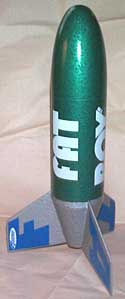
Modified BoatTail FatBoy with a D engine mount, sturdier construction throughout, and better fly-ability with a boat tail. The basic dimensions of a stock Fat Boy were maintained for both body length and fin shape and size.
Modifications:
Body Tube: Cut the main body tube 5 1/8 inch long.
Engine Mount: Glue an engine block in flush with the front of the engine mount. Use both large (CR5080) centering rings at the front of the engine mount. Glue them on at the front of the 2.75 inch BT-50 engine tube. After it is dry, test fit into the main body tube, slide the smaller centering rings onto the engine tube, and use a ruler to locate them in the right spot for a straight boat tail tapered from the back of the main body tube to be flush with the back of the engine tube. The engine mount should be about 1/8 inch into the main body tube and aligned straight to the main tube. When you think you have eyeballed the right location, mark it on the engine tube. Glue one small (CR5060) centering ring on to the engine tube slightly forward of where you marked it. Remember that you are going to glue the second centering ring next to it for strength. Then glue the engine mount about 1/8 inch into the main body tube, again using a calibrated eyeball to ensure both tubes are aligned straight to each other. Use a ruler to check alignment by holding against the aft lips of both body tubes. The ruler should just barely miss the edge of the aft centering ring all the way around. When dry, glue the second centering ring in behind the first, and add reinforcing glue to all the joints.
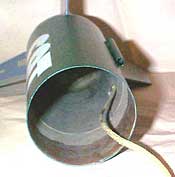 Reinforced Main body tube: Cut a three-inch length of BT-80 tube. Then cut it lengthwise and then cut about 1/4 inch strip off the side of the curled tube. Then test fit inside the main body tube and glue it against the sides of the body tube and butting against the back bulkhead of the body compartment. This is essentially to make a double thick body tube. Then liberally epoxy the bottom bulkhead to body joint. Cut about a one foot length of Pratt small braided Kevlar. Unbraid about one inch per Doug's instructions, and epoxy into the side of the body tube near the aft bulkhead. Tie a loop on the other end and epoxy the knot. Attach an appropriate length of elastic shock cord to this Kevlar loop and eventually to the nose cone. Spread thin CA for about 1 inch around the upper lip of the main body tube and spread it out with a moist paper towel. This also strengthens the end of the body tube to resist tube dings. After this is dry, sand the tube and nose cone to ensure an easy fit.
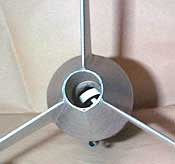 Boat Tail: Design and cut out three balsa wedges to be used as structural support struts under the boat tail. Glue them onto the engine mount about 120 degrees apart on either side of the aft centering ring. Use a shroud calculator to determine the arcs for a 2.5 inch long transition. Draw it on a piece of paper and cut it out for use as a template. Cut about a 5 inch section of BT-80 tube. Slit it down one side, and unroll it enough to trace your transition from the paper template onto the tube material. If you flatten the tube too much, it will crinkle and lose roundness, which you want to maintain. Cut out the boat tail and test fit to the engine mount. Trim to fit. If you trim too much, you may have to re-cut another one until you are satisfied. This is a trial and error process and it took twice to get one I was happy with. Starting with one edge on one of the support struts, glue it down and keep it tight until dry. You may end up with a slight ridge where the edges meet at the strut, but this becomes less obvious with fill & finish and paint. It is really difficult to get the curved BT-80 to accept a smaller diameter curve without crumpling, so you may want to practice this on a test piece.
Fins: Use a standard Fat Boy fin for a template and design and cut your templates for through-the-wall. Maintain the dimensions of the standard Fat Boy, but keep in mind that more fin will be exposed just because of the boat tail. If you do this right, about 1/4 inch of fin will be extended onto the vertical part of the main body tube. You will have to decide how long you want to make your fin extensions to the engine tube. I made mine pretty much all the way from front to back and cut a slit in the extension for the aft centering rings. I have lost the template I used, so I don't have a current sketch. If anyone really struggles with this, ask and I will re-create my fin template for you. Cut slits 120 degrees apart opposite to the three support struts and test fit then glue the fins. Add glue fillets when dry.
Nose Cone weight: Add clay to the nose cone as needed to get the CG about mid point on the rocket. My clay came loose after two flights, so I dribbled epoxy in there to lock down my clay and ended up with a 5 oz. rocket with no engine. My CG is now about 1/2 inch forward of midpoint.
Construction:
- 2 feet of BT-80 tube
- BT-50 D engine mount tube and engine block
- 2 card stock centering rings for BT50-BT80
- 2 card stock centering rings for BT50-BT60
- 1/16th inch plywood for three TTW fins
- 1/16th inch balsa for boat tail strength wedges
- 3/16th inch launch lug
- standard BT-80 Nose cone for Fat Boy
- Pratt braided Kevlar shock cord
- Fat Boy decal set
Gotchas: If you don't get the engine mount aligned vertically with the main body tube, the rocket won't fly straight and the boat tail won't fit right. This is really an eyeball and trial and error process. The aft bulkhead joint is the weakest link and must be liberally glued on both sides of the forward centering ring. Don't add the extra glue until the shroud struts have been added, and liberally reinforce these as well.
Sturdiness: This rocket is very sturdy and feels a lot more solid than a stock FatBoy.
 Finishing:
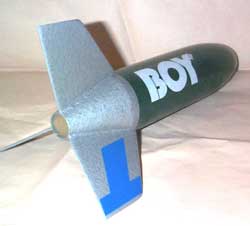
A lot of sins in the construction of the boat tail can be smoothed out with full strength Elmers Fill & Finish. Paint as desired. As you can see from the photo, I made a two-tone scheme using some Rustoleum hammered metal paint over grey primer. I then put on the standard Fat Boy decals as shown.
Flight:
I flew it first on a C6-3 with an engine adapter, and then twice on a D12-3. All flights were hot straight and normal. Recovery was fine on an 18 inch chute.
Summary:
PRO: excellent flight stability due to boat tail and nose weight, and consequently slightly more fin surface than a regular Fat Boy. It even flew better than a regular FatBoy on a C engine even with the extra weight due to much less drag. Keeping the same basic dimensions of height and fin shape enable easy comparison to a stock FatBoy which a lot of people are familiar with.
Other:
I conclude that the main reason for flight instability and low altitude on stock FatBoys is not the girth, but the 2.5 inch diameter flat area at the tail making a C engine barely capable of overcoming these shortcomings.
#Related Reviews
- 2 Fat By Geof Givens
Brief: After a spell of creative scratch rocket projects, all my fun ideas seemed to have dried up. Looking around the workshop, I smiled at good old Fat Boy: both my kids and my favorite rocket. He's always good for an exciting flight and safe recovery. Why not court disaster by trying to improve ...
- Excelsior Rocketry Der Fat Max By Bill Eichelberger
I always loved the versatility of the Estes Fat Boy, and over the years I bought quite a few of them for different projects, most of them of the Goony persuasion. When a fellow club member decide to move away from low power and offered one for sale from his stash, I jumped at the ...
- Fat Boy to AttaBoy Modification By Tad Scheeler
The ATTABOY is a boattailed FATBOY with 24mm upsized motor mount that can be flown in two different configurations--both with and without upper payload tube. Modifications: I was inspired by Michael Bade's " Big Bad V-2 Daddy ", Kevin Johnson's " OY!FATBOY ", and David Fergus' " Boattail FATBOY ...
- Modification 24mm Fat Boy By Morgan Hendry
This project began when I read several posts from rec.model.rockets on placing a 24mm motor mount in a Fat Boy, normally a 18mm kit. I first looked at the instructions and made a list of what I needed to do. Replace the 18mm motor tube with a 24mm one Make bigger motor mount with modified ...
- Modification Fat Boy - 24mm By Morgan Hendry
This project begun when I read several posts from rec.model.rockets on placing a 24mm motor mount in a Fat Boy, normally a 18mm kit. I first looked at the instructions and made a list of what I needed to do. Replace the 18mm motor tube with a 24mm one Make bigger motor mount with modified ...
- Modification Fat Boy - 24mm By Colin Westgarth-Taylor
An Estes Fat Boy modified with a 24mm MMT for D and E motors. External dimensions are stock. These modifications change one of Estes best packaged kits into a true performer. Modifications: Construction sequence was pretty normal for a MPR capable rocket: forward CR epoxied to the MMT, shock ...
- Modification Fat Boy - 29mm By Scott McLeod
An Estes FatBoy modified with a glassed body tube, 29mm MMT and G10 fins for F, G, and H motors. External dimensions are stock. Best "bang-for-buck" rocket that I ever built. Modifications: When glassing the tube, I used a long section of PML 2.6" coupler tube wrapped in greaseproof ...
- Modification Fat Boy to Schnoz By Larry Brand
The problem with overpowering a "stubby" design like the C-powered Estes Fat Boy with heavier engines is the CG dilemma -- the more power, the more nose weight is needed to keep the CG in limits, negating the Oomph you thought you were adding. I have modified Fat Boy for F-power with a ...
- Modification Super Baby Bertha By Kevin Johnson
Took a Fat Boy kit and added Big Bertha like fins to make a Super Baby Bertha. Modifications: NARHAMS held a Fat Boy theme sport launch this month, and I was looking for something different to do with my last Fat Boy kit. I had just finished repairing my Super Big Bertha when inspiration ...
- Modification Two-Stage Fat Boy By Kevin Johnson
Kit bashed two Fat Boys into one two-stage rocket. Modifications: After building the sustainer per the instructions, I started the booster by building the motor mount/center rings. Using the completed mount as a guide, I marked the aft end of the second BT and cut it down just in front of ...
- Scratch Fat Boy (7 x 18mm Motor Eater) By Dick Stafford
This Fat Boy flies on seven 18mm motors. Modifications: Here is what I changed: The base of the cone was cut off The stock centering rings were not used Additional 18mm motor tubes were added Parts list: Estes Fat Boy kit 18mm tubing for the 6 additional motor ...
- Scratch Fat-Ass-Tron Sprint By Jim Sekol
Fat-Ass-Tron Sprint The Fat-Ass-Tron Sprint: The F-A-T Sprint is a combination of the Estes Fat Boy, and the Astron Sprint. It was originally created to address one of the Fat Boy's inherent design flaws, that being ...
Related Products
 |
 |
Flights
Sponsored Ads


|
|