| Manufacturer: | Clone |
| Style: | Futuristic/Exotic, Glider |
Brief:
Back in 1977, the Condor was the second rocket I ever owned and the first "big" rocket I ever flew. (The Beta was my first.) This was my most prolific flier, and bore the battle scars on both booster and glider to prove it.

Construction:
Materials: (according to original plans. I used the closest thing available.)
- 1 - BT-50
- 1 - PNC-50 3/32" balsa stock for fins and glider body
- 1/16" balsa stock for glider wings and canard
- 18mm Engine mount from Estes Regular Engine Mount kit
- A too short length of shock cord
I had been planning to build this from memory, but back in February my brother-in-law and I discovered JimZ's OOP Estes plan site on a Friday night, and on Saturday I hit a local hobby shop and by late afternoon, had all of the parts needed to recreate the Condor. One change that I made was to upgrade the kit from the original 13mm engine to an 18mm. This was something that had always puzzled me about the original. It always seemed a bit big for a mini-motor, but I guess Estes had their reasons. Back then it made sense for me from an economical standpoint, (I got an extra flight per package,) but now that money is no object, I decided to power it up a bit.
Back when I built the original I just slapped it together with glue, painted it, decal'd it and got it in the air as quickly as possible. It flew great! This time I was determined to take my time and employ some of the techniques I had learned about over the 24 years since I built the original. I carefully shaped the fins on the booster, determined to make it as aerodynamic as possible. I also used several coats of thinned Elmer's Fill'n'Finish as a sealer, sanding between coats. Elmer's glue was used both to attach the fins and to create the glue fillets to keep them in place.
The glider was lightly sanded, then sprayed with a coat of Walmart white paint, the same as the booster. I then masked off the front portions of both the glider and booster and sprayed them with Walmart red. It never occurred to me to use the Fill'n'Finish to fill in the body tube spirals or use primer. (Then again, neglecting to do this made it look a lot more like my 1977 original.) JimZ decals completed my retro project.
Flight:
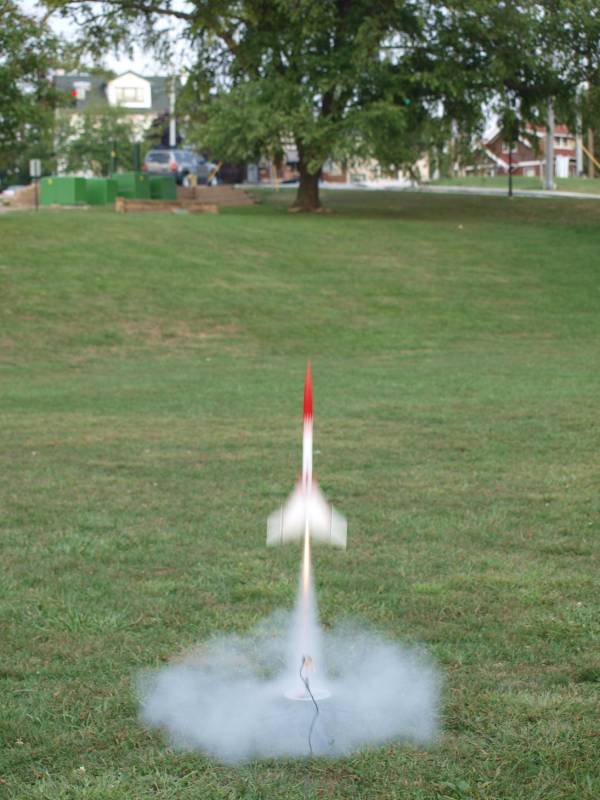
The Condor originally flew on 13mm motors, so I had no benchmark to go on in determining motor selection. Because of this I chose the reliable old Estes B6-4 for the first flight. Fireproof insulation (treated shredded newspaper) was used as recovery wadding, and worked flawlessly. It's available in bulk at most home improvement stores and a little goes a long way.
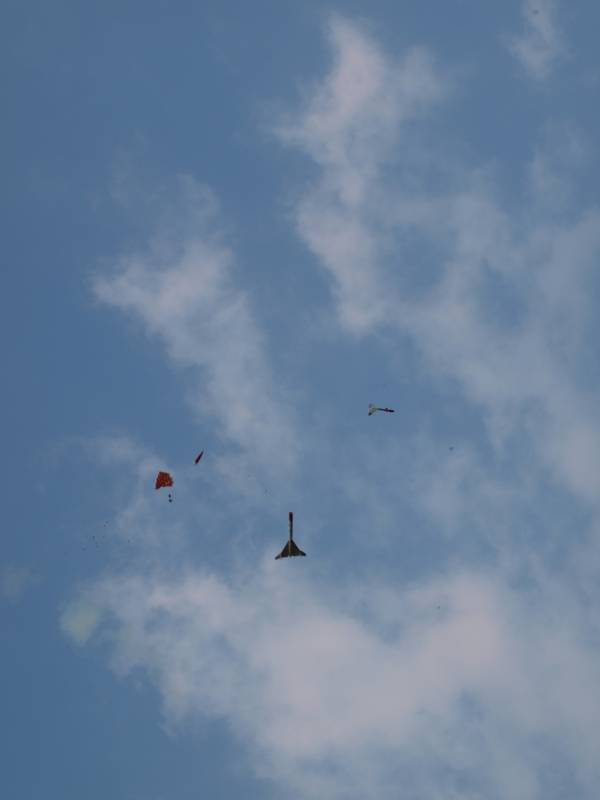
The flight was straight and stable into a light breeze, picture perfect until the ejection charge went off. The sound that the nose cone made when it rebounded back into the body tube was clearly audible on the ground. The glider, which I had trimmed by sticking straight pins into the nose and which had flown so well when I had tested it the previous weekend, made a beeline for the ground on an 80-degree angle and broke on impact just behind the canard. The booster's 12" parachute worked perfectly, and the only evidence of contact between body tube and nose cone was a light scrape, almost a smudge, on each of them.
I flew it one more time that day on a stray Estes A8-3 that had been rolling around my range box for a few months. This time the flight was understandably lower and glider-less, and the sound of the nose cone and body tube meeting was once again clearly audible. My luck didn't hold out this time. The top of the body tube was badly crushed, but repairable. In this sense it was a lot like the old days. It seemed that I was always repairing my original Condor after either the booster or glider made contact with one hard surface or another. (We flew out of an asphalt parking lot back then.)
Summary:
While it was great seeing the Condor on the flight line again, and the flight itself was very satisfying, the glider's suicide dive and the short shock cord rained on my parade a little. PRO'S: The upgraded engine made for a much improved flight and it's always great to see an old timer fly again. CON'S: Cheap feel to the balsa. Glider performance. Shock cord too short. Worst of all, my original is probably a part of a landfill somewhere.
Other:
1) Don't be stingy with the shock cord. Just because Estes does it doesn't mean you have to. Treat yourself to some quality elastic and some Kevlar®. 2) Use Elmer's Fill'n'Finish for not only the fins, but to fill in the spirals in the body tube.
Related Products
 |
 |
Flights
Sponsored Ads


|
|