| Construction Rating: | starstarstarstarstar_border |
| Flight Rating: | starstarstarstarstar_border |
| Overall Rating: | starstarstarstarstar_border |


Brief:
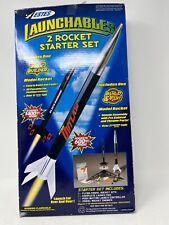
This is an easy to build Estes Rocket (E2X Series) sold as part of the "Launchables" Starter Set (1452). It
requires no paint and no fin alignment and is an easy first build. The starter set includes a Porta Pad II, Electron
Beam Controller, Two Engines (A8-3 and B4-4), the Astron Outlaw, and the Black Diamond, which is a level 1 kit that the
buyer can build after they have learned the basics with the Outlaw.
Construction:
Parts list:
- 1 Body Tube
- 1 Launch Lug (preinstalled on body tube)
- 1 Shock Cord (preinstalled on body tube)
- 1 Nose Cone (chrome colored) (PNC-56A)
- 1 12" Parachute (preassembled
- 2 Fin Halves
- 1 Engine Lock Ring
- 1 Decal Sheet
The instructions are simple enough for even a first time builder to follow along with. The supplies needed are limited: a modeling knife, glue, masking tape, and sandpaper. The assembly flowed without problems whatsoever. The fin halves are glued together (forming the engine mount when glued together) and the engine lock cap secures the engine in place. The fin/motor mount assembly fit flawlessly into the body tube as did the nose cone. There were no alignment issues and once the rocket was glued (use plastic cement for this), it was very sturdy. No complaints in terms of the construction.
Finishing:
There is really no finishing required for this rocket. The body tube comes colored, and both the nose cone and the
two fin halves are decorated with chrome. The appearance of the rocket is better than most E2X or Ready-To-Fly builds
but still leaves something to be desired in that it looks somewhat more like a toy than a model. Still, it is a great
rocket for a first build and the finished product is fairly impressive.
Construction Rating: 4 out of 5
Flight:
The recommended motors are: A8-3, B4-4, B6-4, C6-5.
Preparation: Estes stated that 4-5 sheets of wadding should be used. I would recommend 5-6 sheets as my parachute got burned on the second flight. Spike and fold the parachute, roll it, wrap the shroud lines around it, and insert it into the body tube. Replace the nose cone. Insert the engine into the fin/engine mount unit. Place the engine locking cap over the engine, and twist securely until it is fully locked.
1st flight: I launched first with the lowest power engine (A8-3) in order to test the stability of the rocket. The rocket launched off the pad straight, but the flight was slow and uninspiring. The flight was not straight due to heavy wind conditions. The A8-3 is not in my opinion sufficient to launch this rocket. The combination of heavy wind and low power of the A8-3 meant that ejection occurred after apogee, resulting in a somewhat parabolic flight. The parachute worked well, however, the rocket returned safely to the ground without problems. I would recommend using a snap swivel (found at any store that has fishing equipment) to attach the chute to the shock cord as it twists heavily during flight.
2nd flight: Certain that the rocket was safe to fly on stronger engines, I used a C6-5 for the next flight. The rocket was much more impressive used on this motor. It flew very straight and to a respectable altitude, but the rocket's size kept it in sight so that I wouldn't lose it. The parachute ejected a little before apogee and carried the rocket fairly far away due to slight wind. The chute got a little burned and did not unfold as well as it should have, but it still landed with only a small dent in the body tube. Once recovered, I unfolded the chute where it got burned and it is as good as new so use a little extra wadding if you are worried.
Recovery:
The shock cord is attached to the body tube from the factory and requires no assembly. It appears to mount on the
inside of the launch lug. The cord is a little too short. The parachute twists heavily on descent. I recommend
remedying this by using a snap swivel for fishing line to allow it to twist without tangling the shroud lines. I also
may try replacing the 12" chute with something smaller if I can find it or even choking up on the shroud lines so
that it isn't so large when it unfolds. A streamer might even be acceptable as my Astron Outlaw landed on a paved
pathway during a launch the other day after the chute got tangled and didn't suffer any damage. The reason behind
altering the 12" chute is that it is just too big for the rocket and carries it far away after ejection.
As far as the damage from burning, I only experienced a minor burn on the 2nd flight which caused the chute to stick to itself and not unfold properly. I have since used at least 5 sheets of wadding in all my launches and have had no problems with burned chutes.
Flight Rating: 4 out of 5
Summary:
The Launchables starter set was a great way for me to get back into the hobby. I had been out of it for many years
and needed all the basics to start over since much of my old rocket stuff had been broken. I would recommend it to
anyone who needs a new launch pad like I did, since you get so much extra stuff with it, and it is actually cheaper
than buying a launch controller and launch pad together. This would also be a great gift to introduce someone to the
hobby since it includes an E2X (easy to build) rocket as well as a slightly more intricate skill level 1 rocket that
requires fin alignment and painting.
Overall Rating: 4 out of 5
Other Reviews
- Estes Astron Outlaw By Tim Duncan (March 23, 2007)
This rocket is part of Estes Launchables Starter Set and is aimed at newcomers to the hobby. The package says that it takes less than an hour to assemble and does not require any painting. The kit comes with one body tube that already has the launch lug and a 1/8" x 18" elastic shock cord attached, two fin halves, one lock ring, one nose cone, an assembled 12" plastic parachute, and ...
 |
 |
Flights
Sponsored Ads




|
|