| Manufacturer: | Clone |
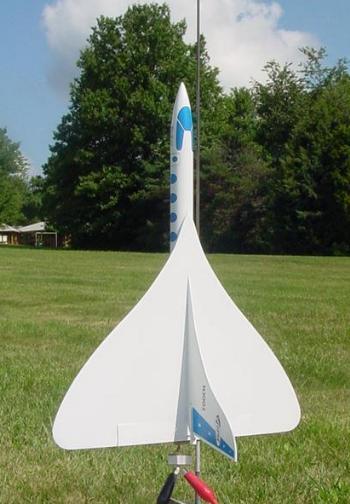 Brief:
The Estes Skydart is classic design from rocketry's heyday. Designed by Larry Renger, the Skydart provides both sexy, good looks and great performance. It's a boost-glider that launches vertically and then ejects a 'power pod' at apogee. The power pod returns via parachute and the glider circles down for a gentle landing.
Construction:
I had built the Skydart kit in my youth but lack of age and experience never allowed me success with this rocket. I have always wanted to clone one but have never gotten around to it. Finally it was time. Since I already had the instructions from my previous kit all I needed was the patterns to make the wings and fin. I downloaded them off of JimZ's website and printed them. However, something didn't look right when they were printed out. The printed size was too small. After some fiddling on the copy machine I was able to scale them to the correct size. I had the original wingspan from the Estes catalog so that's how I was able to get them sized correctly.
The bill of materials is listed on the original kit's instruction page so all you need to do is gather the parts together and start building. I was able to get the length of the main BT-50 body tube off of Sven Knudson's web page and the nose cone from BMS and their classic Estes cone reproduction offering.
The power pod tube will be the wrong length if you go by the chart on Sven's site. It needs to be longer. I made mine using my calibrated eyeball and looking at the picture of the parts included on the original kit instruction sheet. (the power pod tube should be about 1/2" shorter than the main body tube) All the other parts are available as aftermarket items from Estes, Totally Tubular or similar. The elastic cord for the elevator can be obtained at any good craft store that sells sewing supplies and the nylon screw used for adjusting the elevator trim can usually be found at most good hardware stores (my local TrueValue carries a good supply of nylon screws, washers, nuts and bolts). You will also have to make the elevator retaining hook. I made mine from paper clip wire. There's a good picture of it on the BOM sheet as well as illustrations in the instructions. From these it should be no problem forming your own.
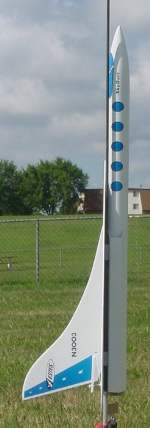 Building the Skydart is straightforward. The balsa parts will need to be cut out, rather than die cut as furnished in the original kit. I cut mine from 3/32" balsa sheet. If you want a light model I suggest using contest grade balsa. You'll need to be more careful in handling and transporting since this balsa is more prone to breaking. I used medium grade density for my Skydart since I like to have my models a little more durable. Stay way from hard or really dense balsa though. All you'll be doing is making a brick then.
After cutting all the parts then assembly is per the original's instructions. No real gotcha's here. I did substitute BB's for the lead weight disks used in the front of the power pod, however. These lead disks are used to keep the CG forward during the boost phase of the flight prior to ejection of the pod. I haven't been able to find any extra disks or any data on how much they actually weighed. So I sort of fudged it here. I installed a bulkhead in the BT-20 ahead of the vent holes I drilled then filled this area with BB's up to the top of the tube. Then I mixed up 30 minute epoxy and poured it over the BB's. The 30 minute epoxy is thin enough to flow in and lock the BB's in place.
I used CA glue for the majority of construction. Even when gluing the wing parts together I used CA (just not a whole lot so as to prevent sanding the joints for a good appearance). The nacelles were made from manila folder type card stock. Amazingly the pattern on the JimZ site printed the correct size. I pre-scored the fold lines and then used a metal straight edge to get a nice clean crease. These were glued in place with Super Tacky white glue. This allowed time for positioning them but also allowed a quick set up of the adhesive.
Rather than using the original elevator hinging method of adhesive paper strips I opted instead to use a strip of Monokote. I already use this for my R/C planes so I'm quite familiar with it. It is a heat shrink, heat activated adhesive backed mylar that's used to cover model airplanes. It also makes great hinge material. I positioned the elevator and ironed on a strip of it in the hinge location and that was that.
Finishing:
Finishing the Skydart requires a lot of grain sealer. This model has a lot of balsa surface are to seal so take care not to add too much or your weight will increase dramatically. I used water based Kilz primer with some light sanding between coats. I like this stuff even though most guys prefer traditional sanding sealer. After the whole rocket was prepped and the grain sealed it was given a final finish sand then primed and painted with Krylon paints.
The decals were made by me. I downloaded the file from JimZ the did a little editing in photoshop. Mostly all I did was to give the colors a little more intensity. Even though they look good on the screen when you print them the hue never looks quite the same. I printed a sample first to get the size right then ran the final copy on photo paper. I took the master copy to Kinko's and had them print the final product on my blank decal paper using their laser copier. I suppose I could have ordered them from Tom Prestia at Tango Papa but I wanted to do these on my own. The decals were applied and the model was given a coat of Krylon clear.
At this point I checked the CG of the glider. the plans tell you exactly where the glider should balance. Mine was just right, perhaps a bit nose heavy. I was prepared to add some weight by putting some clay to the base of the nose cone but this wasn't needed. The nose down trim could be taken care of by the elevator trim screw later on if needed.
Flight:
With a boost-glider you have to trim fly the glider before you ever load and engine in it and fly. I went out to the usual park we fly at and did some trim flights. Giving a straight ahead toss showed I had too much elevator travel. After a few more tosses I found I needed hardly any elevator trim to get a nice flat glide. Although this may seem obvious, you trim fly the glider without the power pod in place.
The recommended motors for this boost glider are Estes B4-2, B6-2 and C6-3. I opted for a fist flight using a B4-2. The 12" parachute was wrapped carefully around the power pod and then the pod inserted into the glider. You have to make sure the elevator retainer is engaged and holding the elevator in the neutral position for boost. The motor is retained using a standard Estes engine hook. I installed the motor and ignitor and headed for the pad. This model uses a 1/8" launch rod. Since there was no wind I didn't angle the rod. In any case I have yet to figure out which way a boost-glider will go off the pad so straight up seems to be the best choice for me. I took the obligatory first photos then proceeded to launch. The model arced over a bit on boost and reached an apogee of about 250'. The pod ejected smartly and the glider flew very well. It had a slight left wing down which caused it to circle. The Skydart landed at that low wing angle but there was no damage.
Post flight investigation revealed that the left wing was heavier than the right. I had failed to do a lateral balance of the model. A tiny amount of clay to the right wing tip fixed this. Subsequent flights proved it out. I haven't flown it yet on a C6-3. I flew my Scissor Wing Transport on a C and it almost flew away so I am a bit more cautious this time with the Skydart.
The Skydart was fun to build. I have heard of other people selling clone kits of this rocket. If you prefer to have everything ready to build then perhaps that's the route for you. As for me I enjoy recreating the classics from scratch. The Skydart is a welcome addition to my fleet.
Related Products
Sponsored Ads


 |
 |