Estes Design of the Month Space Freighter Plan
Estes - Space Freighter {Plan}
Contributed by Dwayne Surdu-Miller
| Construction Rating: | starstarstarstarstar_border |
| Flight Rating: | starstarstarstar_borderstar_border |
| Overall Rating: | starstarstarstarstar_border |
| Manufacturer: | Estes  |
Brief: Construction:
The original plan parts list calls for a PS-50A payload section that included a 4" clear plastic payload tube, a 1" balsa nose block (a solid balsa cylinder), and a BNC-50J balsa nose cone. I substituted a Quest payload section that is red transparent plastic and 4" long, a Quest nose cone, and a balsa nose block that I turned on a lathe.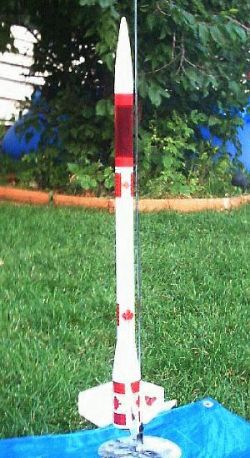
This is a nifty "Rearward Ejection Payloader" design by Scott Amundson. It won an Estes Design of the Month Contest in 1968, published as Estes Industries Rocket Plan Number 54 in Model Rocketry News.
Required parts include:
The original parts list calls for 36" of Estes SC-3 shock cord. I substituted a couple of lengths of Kevlar cord and a round elastic cord. I added the piece of wire to retain the motor in the motor mount, as I didn't like the idea of relying on friction fitting the motor in the power pod. Also, the plans also call for four RA-2060 paper adapter rings. I substituted some 1/16" thick card stock that's more rugged. Lastly, I fabricated a few items that were not locally available, including the balsa nose block, the balsa adapter, and the paper adapter rings.
The plan's instructions were easy to follow with diagrams that clarified the text nicely. However, I didn't like the way the shock cord was supposed to be attached. The shock cord was originally to be inserted through a slit in a fin, then held in place with a glued strip of gauze. I thought this would expose the shock cord to deflected motor exhaust at launch time and the gauze attachment looked very permanent. Instead, I drilled a small hole in the fin, threaded the hole with a 9" length of Kevlar cord, and tied the cord to itself making a loop around the fin. I tied the remaining free end of the cord to a round elastic shock cord. I also didn't like the friction-fit motor idea. I felt that getting a friction-fit motor out of the power pod would be a royal pain and that the friction fit motor would not reliably kick the pod out at ejection time, which would be disastrous. So to improve reliability and convenience, I added a motor retaining wire to the pop pod.
Finishing:
I used sanding sealer and 400 grit sanding paper to seal/smooth the fins and the balsa adapter. I spray painted the rocket body, minus payload section and nose cone, with Krylon White Primer then with Krylon Gloss White. The nose cone was already white so I didn't paint it. I then added finishing touches with Pactra Trim Tape and some snazzy iridescent stickers that were locally available.
Construction Rating: 4 out of 5
Flight:
The plans recommend A8-3, B6-4, B14-5, and C6-5 motors. I suggest that A8-5, B4-6, B6-6, and C6-7 motors might be more appropriate since the rear ejection works a bit better after apogee with the model in nose down position.
Parachute preparation requires a bit of care since the chute, lines, and cord must be arranged on the power pod before the pod is inserted into the rear of the body. The pod's centering rings are only about 1.5" apart so the available space is pretty small. Getting the power pod into the body is a bit iffy as well, since the shock cord, chute, and shroud lines must not be squished between the pod's centering rings and the body, otherwise the fit may be too tight. At least it doesn't need wadding. Once the pod is inserted, inserting the motor is easy. Just insert the igniter and plug into the motor and insert the motor into the pod.
First flight was with an A8-3 with 10 mph winds. The model boosted smoothly straight up with no noticeable spin or weathercocking.
Recovery:
The model was approaching apogee still pointing straight up at ejection time. The pod popped out nicely and the parachute deployed. This looked a bit odd, as the parachute seemed to act as a drag chute with the model over the parachute for a short while. The model then swung under the chute and descended at a moderate rate. The chute was only half open on the way down. I found later that the shroud lines were not evenly tied. Despite that, the model landed gently in the grass with no damage. Next time, I will use a longer coast duration to avoid the "drag chute" behavior.
Flight Rating: 3 out of 5
Summary:
The main PROs of this model are impressive flight performance, good looks, and rear ejection. I had used the rear ejection idea with my Boddomuk design for Descon 11 and have had great success with it although it always works better when the rocket is pointing down at ejection time. I am eager to try a night flight with this model with a small glow tube as payload.
The main CON of this model is that flight preparation is iffy with getting the chute, shroud lines, shock cord, and power pod stuffed into the rear of the model.
Overall Rating: 4 out of 5
Sponsored Ads






 |
 |